 RapidHeat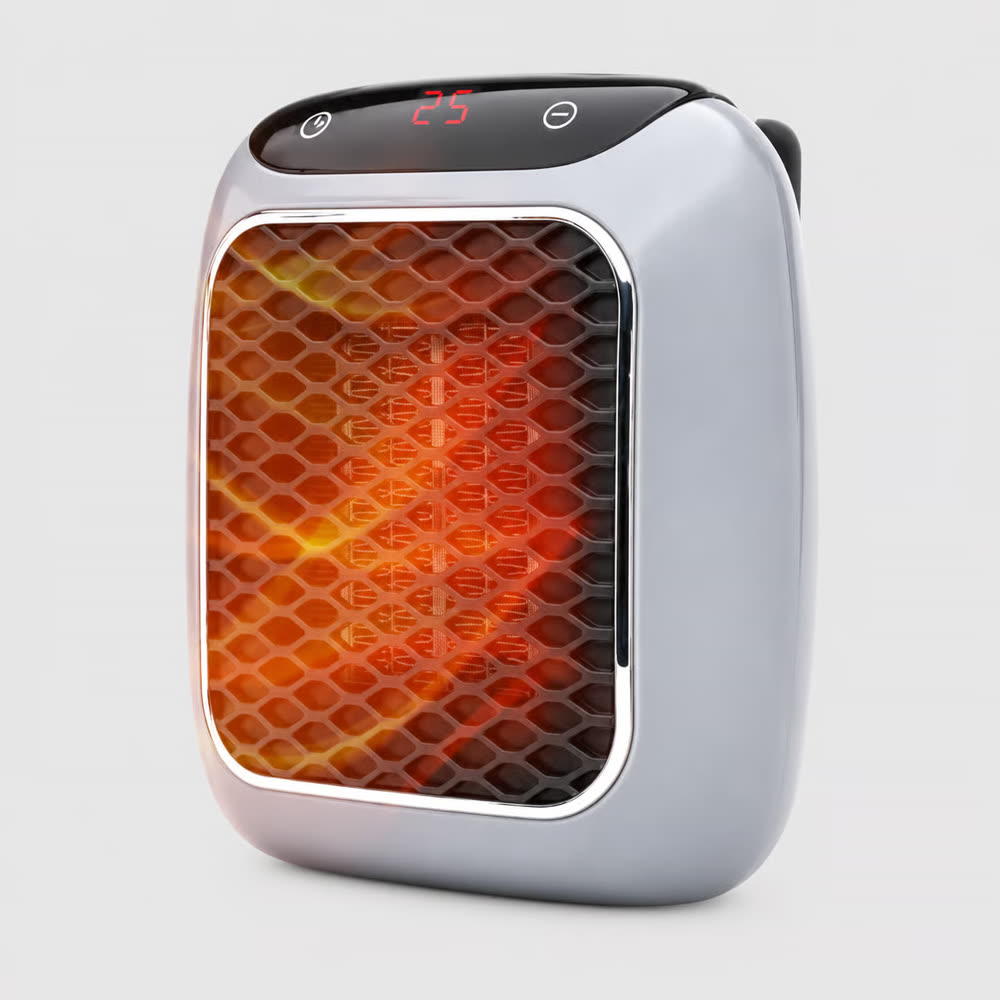
Quick answer
RapidHeat's running cost depends on its wattage, which the seller does not clearly publish. As a guide, a heater costs its power in kW multiplied by your electricity rate per hour: at 27p per kWh a 400W heater costs about 10.8p an hour and a 1kW heater about 27p an hour.
What we checked: We used the standard kW × rate formula, an example UK rate of 27p per kWh, and the seller's published information. Wattage was not confirmed by the seller. Last reviewed 11 October 2026. How we research.
Key takeaways
- At 27p per kWh, about 27p per hour on the 1.0 kW setting and about 40.5p per hour on the 1.5 kW setting, at full power.
- Only for short use. 22p buys about 0.8 kWh at 27p per kWh — around half an hour on the high setting at full power.
- Per unit of heat, gas central heating is usually cheaper than electric heating in the UK.
- It depends on its wattage. At 27p per kWh, every 100W costs about 2.7p per hour, so a 500W setting would be about 13.5p per hour.
- The seller did not clearly publish the wattage when we checked.
Every electric heater’s running cost follows one formula: power (kW) × hours × unit rate. Using the seller-stated power settings and 27p per kWh (an example rate close to recent UK tariffs — check your own bill), here is what RapidHeat costs to run.
Cost per hour
Low setting (about 1.0 kW): 1.0 × 27p = about 27p per hour at full power.
High setting (about 1.5 kW): 1.5 × 27p = about 40.5p per hour at full power.
These are worst-case figures. Once a room reaches the thermostat temperature the heater should cycle, lowering the average — but by how much depends on the room, insulation and outside temperature. We have not measured it.
Cost per day, week and month
At 4 hours a day on full power:
- Low: £1.08 a day · £7.56 a week · £32.40 for 30 days
- High: £1.62 a day · £11.34 a week · £48.60 for 30 days
Fact-check: “£0.22 per day”
Marketing material for RapidHeat mentions “£0.22 per day”. At 27p per kWh that equals about 0.8 kWh — roughly 33 minutes on the high setting or 49 minutes on low at full power. We could not find the usage assumptions behind the figure, so treat it as a best-case illustration rather than a typical daily cost.
Can RapidHeat lower your energy bill?
It cannot make electricity cheaper — all resistive electric heaters convert electricity to heat at essentially 100% efficiency. Savings are only possible if warming one small room replaces heating your whole home. If your central heating would otherwise run for those hours, a small heater in a single room can cost less overall; if it simply adds to your heating, your bill will rise.
Running cost table: every common heater wattage
Because the seller does not give a clear wattage, here are costs for the power levels small plug-in heaters usually run at. Find the line that matches the label on your heater or the seller's confirmation.
| Heater power | Per hour | 5 hours a day | Per week (5h/day) | Winter (750 hours) |
|---|---|---|---|---|
| 400W | 10.8p | 54p | £3.78 | £81 |
| 600W | 16.2p | 81p | £5.67 | £121.50 |
| 800W | 21.6p | £1.08 | £7.56 | £162 |
| 1,000W (1kW) | 27p | £1.35 | £9.45 | £202.50 |
| 2,000W (2kW) | 54p | £2.70 | £18.90 | £405 |
| 3,000W (3kW) | 81p | £4.05 | £28.35 | £607.50 |
How to work out the exact cost on your tariff
Take the heater's power in watts and divide by 1,000 to get kilowatts. Multiply by the unit rate on your bill (in pence per kWh). That gives the cost for one hour at full power. Multiply by your hours of use.
Example: an 800W heater on a 24.5p tariff: 0.8 × 24.5 = 19.6p per hour. Four hours every evening = 78.4p a day.
If your heater has a thermostat, it will cycle on and off once the room reaches the set temperature, so actual cost is often lower than the full-power figure. A smart plug with energy monitoring will show you the real figure.
The '£0.22 a day' claim explained
The seller says RapidHeat costs around £0.22 a day. At 27p per kWh, 22p buys about 0.81kWh of electricity — roughly two hours of a 400W heater, or under an hour at 1kW. That is possible for light use, but it is not a figure for heating a room all evening. We list it as a seller claim, not a verified cost.
When a small heater saves money — and when it doesn't
A small heater saves money when it lets you turn the central heating down or off while you sit in one room. Heating one small room with a 500W heater for four hours uses 2kWh; running a typical gas boiler for the whole house for the same time usually uses far more energy, although gas costs less per kWh than electricity.
It does not save money if you run it alongside full central heating, use it to try to heat a large or draughty room, or leave it on in empty rooms. Electricity costs roughly three to four times more per kWh than gas under the UK price cap, so a heater that runs for long hours can cost more than gas heating.
Example: one winter evening routine
Imagine you sit in a small 6m² snug from 6pm to 10pm every evening from November to March (about 150 evenings), with the central heating off in the rest of the house. A 600W heater running at full power for four hours uses 2.4kWh, which costs about 65p at 27p per kWh — roughly £97 over the winter.
With a thermostat cycling the heater off for a third of the time once the room is warm, the real figure could be closer to £65. These are worked examples, not measured results for RapidHeat.
Prepayment, Economy 7 and fixed tariffs
On a prepayment meter you pay a similar unit rate to direct debit under the price cap, so the same formula applies. On Economy 7, electricity is cheaper at night but more expensive during the day — a heater used mainly in the evening may cost more per hour than on a standard tariff. On a fixed deal, use the unit rate on your latest bill.
Is RapidHeat right for you?
Likely a good fit if you…
- Want to warm one small room or desk area
- Want to keep central heating off while you sit in one room
- Have no floor space for a radiator
- Value a 30-day money-back guarantee (per seller)
Probably not for you if you…
- Need to heat a large, open-plan or draughty room
- Expect it to replace central heating or cut bills dramatically
- Need a heater for a bathroom
- Need published wattage and certificates before buying
Frequently asked questions
How much does RapidHeat cost to run per hour?
At 27p per kWh, about 27p per hour on the 1.0 kW setting and about 40.5p per hour on the 1.5 kW setting, at full power. Thermostat cycling can lower the average.
Does RapidHeat really cost 22p a day?
Only for short use. 22p buys about 0.8 kWh at 27p per kWh — around half an hour on the high setting at full power. We could not verify the assumptions behind the seller’s figure.
Is RapidHeat cheaper than central heating?
Per unit of heat, gas central heating is usually cheaper than electric heating in the UK. A small heater can still cost less overall if it means you heat one room instead of the whole house.
How much does RapidHeat cost per hour?
It depends on its wattage. At 27p per kWh, every 100W costs about 2.7p per hour, so a 500W setting would be about 13.5p per hour.
What wattage is RapidHeat?
The seller did not clearly publish the wattage when we checked. Ask customer support or check the label on the unit.
Is it cheaper to run a plug-in heater or central heating?
Heating one small room with a low-power heater can be cheaper than heating the whole house. Per unit of heat, gas central heating is usually cheaper than electricity.
How can I measure what my heater costs?
Use a plug-in energy monitor or a smart plug with energy tracking, or read your smart meter display before and after an hour of use.
Does the thermostat reduce running costs?
Yes. Once the room reaches the set temperature, the heater cycles off, so it uses less than its full power over time.
How much would RapidHeat cost over a winter?
It depends on wattage and hours. A 600W heater used four hours a day for 150 days costs about £97 at 27p per kWh at full power, less with a thermostat.
Does RapidHeat use more electricity on a high setting?
Yes. Higher settings draw more power, so they cost more per hour.
Sources and further reading
Read our full RapidHeat Heater review for specifications, pros and cons and our verdict.